
Are You a Patient Taking Vidaza or Dacogen?
Posted: February 8, 2016 Filed under: Clinical Trials, CRUSH!!MDS, Laboratory Research, Patient Education, Uncategorized | Tags: Blood Disorders, dacogen, Gail Roboz, Leukemia Treatment, MDS, Myelodysplastic Syndrome, vidaza, Weill Cornell, Weill Cornell Leukemia Program Comments Off on Are You a Patient Taking Vidaza or Dacogen?Seeking Research Volunteers
Predicting Response To Your Myelodysplastic Syndrome (MDS) Treatment
Azacitidine (Vidaza®) and decitabine (Dacogen®) are FDA-approved drugs for the treatment of MDS. While these drugs help many patients with MDS, sometimes patients who initially respond to these drugs eventually lose their response. Why? Why do the drugs stop working? MDS-CRC investigators are trying to answer this question. Through CRUSH!!MDS, we are recruiting patients who have not responded or lost their initial response to azacitidine or decitabine. Patients will be able to have blood drawn at the time of a routine visit to their local doctor and we will arrange for the blood to be delivered to Weill Cornell Medical College, at no cost to the patient. At Weill Cornell, the blood will be analyzed in the laboratory of Dr. Joseph Scandura, M.D.
For more information about the study and the CRUSH!!MDS initiative, please visit our website.
AAMDS Boston Patient & Family Conference
Posted: August 7, 2015 Filed under: Patient Education | Tags: AAMDS, blood cancer treatment, Blood Disorders, cancer, cancer treatment, caregivers, family, hematology, patients Comments Off on AAMDS Boston Patient & Family ConferenceCalling all north east patients and family members. AAMDS is holding a conference on Saturday, September 19 in Boston.
For more information please visit the AAMDS website
Dr. Gail Roboz Discusses Challenges and Progress in Acute Myeloid Leukemia
Posted: November 6, 2014 Filed under: Clinical Trials, Leukemia News, Patient Education, Physician Presentations Leave a comment“AML continues to languish at the bottom of the survival curve. The lymphoid diseases are just doing so much better,” said Roboz, associate professor of Medicine and director of the Leukemia Program at the Weill Medical College of Cornell University and the NewYork-Presbyterian Hospital.
That is not to say, however, that research into myeloid diseases is “completely languishing,” Roboz stressed in her presentation at the 2014 Chemotherapy Foundation Symposium. Real progress has been achieved in understanding AML’s biology, and new targeted agents are being explored to improve outcomes.
For example, Roboz noted, mutations in FLT-3 (FMS-like tyrosine kinase 3) are associated with highly proliferative leukemia and adverse outcomes, while mutations in NPM1 (nucleophosmin 1) and biallelic mutations in CEBPA (CCAAT enhancer-binding protein a) have significantly more favorable survival.
“Although the mechanism of action of AML is much better understood, it’s not simple, and that’s the problem,” Roboz stressed.
Another challenge in treating patients with AML—which Roboz noted results in 10,000 deaths of the approximately 13,000 cases diagnosed each year—is whether more cases will be diagnosed, as patients survive other cancers. “We know that it’s associated with chemo and radiation exposure,” as well as other known environmental risk factors, genetic abnormalities, and benign and hematologic diseases also associated with AML.
Improving on Standard of Care
Although the current cytarabine-based 7+3 regimen remains the standard of care, “we do understand our weapon a little better, and this has certainly resulted in some survival benefit,” said Roboz, adding that this “much-worked-on regimen can be given to much older patients.”
Roboz, who will be leading an AML education session at the American Society of Hematology Annual Meeting in San Francisco next month, reviewed successive efforts by the German AML Study Group “to make chemo better,” through variations on (and additions to) the 7+3 dosing regimen, but these have led to what she described as “superimposable curves.”
“Is it in fact a triumph of hope over experience to add things on to 7+3?” This is a useful question, she elaborated, because “is it that we’re adding new things that aren’t new enough or are we adding them in the wrong place? It’s certainly concerning that all of these efforts over all of these years led to superimposable graphs.”
Other agents are pending, said Roboz, including clofarabine which, she said, “definitely works in AML, but we can’t quite get it right to be where it needs to be an approved drug for AML. We’re anxiously awaiting whether it can ‘beat’ 7+3,” she said.
A phase II study of CPX-351,1 which, Roboz explained, “is taking 7+3 and trying to make it better. This is a formulation that holds cytarabine and daunorubicin in a fixed 5:1 ratio, and we’re waiting to see whether what looked like a benefit in overall survival in a very difficult-to-treat population of secondary AML patients will hold up in a randomized trial, and whether taking the best regimen that we have and making the formulation better will get the job done.”
Roboz also hopes to have data available soon from the multicenter Alliance trial, looking at decitabine versus decitabine plus bortezomib in a 10-day schedule.
Looking ahead, said Roboz, “We have epigenetics, we have targeted therapies, personalized medicine. We must be on the way to improved therapeutic options.”
“Hope springs eternal. We want these agents to work and to synergize with our ‘best regimens,’” she said.
- 1. Lancet JE, Cortes JE, Hogge DE, et al. Phase 2 trial of CPX-351, a fixed 5:1 molar ratio of cytarabine/daunorubicin, vs cytarabine/daunorubicin in older adults with untreated AML [published online March 31, 2014]. Blood.
http://www.onclive.com/conference-coverage/cfs-2014/Roboz-Discusses-Progress-Challenges-in-AML
Dr. Gail Roboz reviews existing and evolving approaches to the treatment of patients with AML for Medscape Education
Posted: May 29, 2013 Filed under: Patient Education, Physician Presentations | Tags: Acute Myeloid Leukemia, AML, Gail Roboz, Gail Roboz MD Comments Off on Dr. Gail Roboz reviews existing and evolving approaches to the treatment of patients with AML for Medscape Education To view the entire presentation and slideshow, click here.
Leukemia Program Nurse Practitioner, Sandy Allen-Bard, Moderates Educational Program on CML
Posted: March 5, 2013 Filed under: Patient Education, Physician Presentations, Uncategorized | Tags: Blood Disorders, cancer treatment, chemotherapy, Chronic Myeloid Leukemia, CML, Leukemia, Weill Cornell, Weill Cornell Medical College Comments Off on Leukemia Program Nurse Practitioner, Sandy Allen-Bard, Moderates Educational Program on CML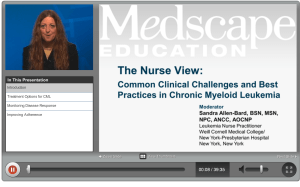 Leukemia Program Nurse Practitioner, Sandy Allen-Bard, moderated a Medscape Eduation program titled, The Nurse View: Common Clinical Challenges and Best Practices in Chronic Myeloid Leukemia. The view the program (which requires that you create a free Medscape account), click here.
Dr. Roboz Speaks on Genomics in AML
Posted: January 18, 2012 Filed under: Laboratory Research, Leukemia News, Patient Education, Physician Presentations | Tags: Acute Myeloid Leukemia, AML, Blood Disorders, cancer treatment, Gail Roboz, Gail Roboz MD, Leukemia, Leukemia Treatment Comments Off on Dr. Roboz Speaks on Genomics in AMLDr. Gail Roboz spoke with ecancertv at ASH 2011 in San Diego about the major genomic research on acute myeloid leukaemia. There has been a lot of recent success on identifying mutations and abnormalities in AML; however, Prof Roboz believes that the discovery period with genomic research is coming to an end and a move towards clinical trials and targeted therapies need to be developed. The largest development has been the role of stems cell in research and how to target the cells that are left over after chemotherapy.

Sandra Allen-Bard contributes to informational video on CML
Posted: August 24, 2011 Filed under: Leukemia News, Patient Education, Physician Presentations, Uncategorized | Tags: Blood Disorders, Leukemia, Leukemia Treatment, New York Presbyterian, Weill Cornell Comments Off on Sandra Allen-Bard contributes to informational video on CMLLeukemia Program Nurse, Sandra Allen-Bard, contributed to an informational video on Chronic Myeloid Leukemia. To view it, click here.

Dr. Gail Roboz Interviewed about Lenalidomide for MDS
Posted: August 2, 2011 Filed under: Clinical Trials, Leukemia News, Patient Education, Physician Presentations, Uncategorized | Tags: Blood Disorders, Gail Roboz, Leukemia, Leukemia Treatment, MD, Myelodysplastic Syndrome, New York Presbyterian, Weill Cornell Comments Off on Dr. Gail Roboz Interviewed about Lenalidomide for MDSCheck out this video interview of Dr. Roboz about Lenalidomide for intermediate and low-grade MDS. Click here to view.
Dr. Gail Roboz Participates in Hematology CME Activity
Posted: July 8, 2011 Filed under: Clinical Trials, Patient Education, Physician Presentations, Uncategorized | Tags: Acute Myeloid Leukemia, AML, Blood Disorders, Gail Roboz, Leukemia, Leukemia Treatment, MD, New York Presbyterian, Weill Cornell Comments Off on Dr. Gail Roboz Participates in Hematology CME ActivityTo view Dr. Roboz’s presentation, click here.

Dr. Gail Roboz Discusses the Causes of Bone Marrow Failure
Posted: July 7, 2011 Filed under: Clinical Trials, Laboratory Research, Leukemia News, Patient Education, Physician Presentations, Uncategorized | Tags: Acute Myeloid Leukemia, AML, Blood Disorders, Gail Roboz, Leukemia, Leukemia Treatment, MD, Myelodysplastic Syndrome, New York Presbyterian, Weill Cornell Comments Off on Dr. Gail Roboz Discusses the Causes of Bone Marrow Failure Click the image to view the presentation.
 Weill Cornell Leukemia Program