
Weill Cornell Medical College Selected to Join New MDS Clinical Research Consortium
Posted: June 19, 2012 Filed under: Clinical Trials, Laboratory Research, Leukemia News | Tags: Gail Roboz, Gail Roboz MD, MDS, Myelodysplastic Syndrome, Weill Cornell, Weill Cornell Medical College Comments Off on Weill Cornell Medical College Selected to Join New MDS Clinical Research Consortium
MDS researchers join forces to advance patient treatments and outcomes
Posted: June 19, 2012 Filed under: Clinical Trials, Laboratory Research | Tags: Blood Disorders, Gail Roboz, Gail Roboz MD, MDS, Myelodysplastic Syndrome Comments Off on MDS researchers join forces to advance patient treatments and outcomesNewYork-Presbyterian/Weill Cornell Medical Center is 1 of 6 institutions selected to participate in new MDS clinical research consortium
NEW YORK (June 18, 2012) — NewYork-Presbyterian/Weill Cornell Medical Center is one of six institutions selected to join the newly-founded MDS Clinical Research Consortium. The Consortium’s mission is to significantly advance treatments and patient outcomes for Myelodysplastic Syndromes (MDS) through innovative research and clinical trials.
The five-year, $16 million multi-institution initiative is the first privately funded MDS research consortium in the United States. It is sponsored by the Aplastic Anemia & MDS International Foundation of Rockville, Md., and supported by the Edward P. Evans Foundation. The Consortium’s funding to Weill Cornell Medical College will support MDS research at NewYork-Presbyterian/Weill Cornell Medical Center.
MDS is a cancer of bone marrow stem cells that inhibits the body’s ability to produce healthy blood cells. The disease can be treated and, in some cases, controlled, but currently, the only cure is stem cell transplantation. The new Consortium will help fill a major gap in the United States for MDS-related clinical research by joining dedicated academic medical centers with a high volume of MDS patients, an established database of current and former patients and a significant track record of participation in MDS clinical trials. The collaboration will facilitate evaluation of promising new compounds, epidemiological studies and translational research studies leading to new classifications, treatments and procedures for MDS.
“MDS is an under-recognized disease. Sometimes we don’t know why a patient has developed MDS, but we do know that those who have been exposed to cancer chemotherapy and radiation therapy are at increased risk,” says Dr. Gail J. Roboz, Weill Cornell Medical College’s principal investigator for the Consortium and director of the Leukemia Program at NewYork-Presbyterian/Weill Cornell Medical Center. “This Consortium offers a wonderful opportunity to develop new therapies and also to profile patients using the latest, state-of-the-art technologies so we can start to understand who gets MDS and why.”
Other Consortium partners include the Cleveland Clinic’s Taussig Cancer Institute, Dana-Farber Cancer Institute, MD Anderson Cancer Center, H. Lee Moffitt Cancer Center and Research Institute and the Sidney Kimmel Comprehensive Cancer Center at Johns Hopkins.
“One of the greatest challenges in research of rare diseases like MDS is having enough patients to conduct meaningful clinical trials. No single center can do it alone. This uniquely collaborative effort overcomes that barrier,” said John Huber, Executive Director of the Aplastic Anemia & MDS International Foundation. “To have these six leading MDS research centers working together in this way is unprecedented,” Huber added. The Aplastic Anemia & MDS International Foundation will expand its programs for MDS patients, their families, and caregivers and local physicians who support and complement the aims and purposes of the Consortium.
“We are extremely pleased to work in partnership with AA&MDSIF and these six outstanding Consortium members. This collaborative endeavor reflects Mr. Evans’ desire to support the highest quality MDS research, which will lead to improved treatments for patients and, ultimately, to finding a cure,” said an Evans Foundation trustee.
View video of Weill Cornell’s principal investigator, Dr. Gail J. Roboz, discussing MDS and the importance of the new MDS Clinical Research Consortium: http://www.youtube.com/watch?v=gBSqofQ1vdY .
Weill Cornell Medical College
Weill Cornell Medical College, Cornell University’s medical school located in New York City, is committed to excellence in research, teaching, patient care and the advancement of the art and science of medicine, locally, nationally and globally. Physicians and scientists of Weill Cornell Medical College are engaged in cutting-edge research from bench to bedside, aimed at unlocking mysteries of the human body in health and sickness and toward developing new treatments and prevention strategies. In its commitment to global health and education, Weill Cornell has a strong presence in places such as Qatar, Tanzania, Haiti, Brazil, Austria and Turkey. Through the historic Weill Cornell Medical College in Qatar, the Medical College is the first in the U.S. to offer its M.D. degree overseas. Weill Cornell is the birthplace of many medical advances — including the development of the Pap test for cervical cancer, the synthesis of penicillin, the first successful embryo-biopsy pregnancy and birth in the U.S., the first clinical trial of gene therapy for Parkinson’s disease, and most recently, the world’s first successful use of deep brain stimulation to treat a minimally conscious brain-injured patient. Weill Cornell Medical College is affiliated with NewYork-Presbyterian Hospital, where its faculty provides comprehensive patient care at NewYork-Presbyterian Hospital/Weill Cornell Medical Center. The Medical College is also affiliated with the Methodist Hospital in Houston. For more information, visit weill.cornell.edu.
Leukemia Program Director, Gail Roboz, Interviewed on CNN’s “The Situation Room”
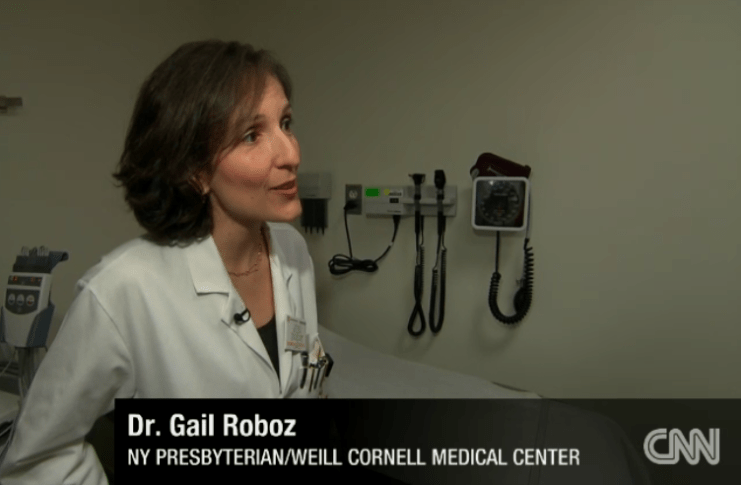
Posted: June 12, 2012 Filed under: Leukemia News, Physician Presentations, Uncategorized | Tags: Blood Disorders, Gail Roboz, Gail Roboz MD, MDS, Weill Cornell Comments Off on Leukemia Program Director, Gail Roboz, Interviewed on CNN’s “The Situation Room”Dr. Roboz describes the symptoms and treatment of Myelodysplastic Syndrome. Click the image to view her interview.
Dr. Roboz Speaks on Genomics in AML
Posted: January 18, 2012 Filed under: Laboratory Research, Leukemia News, Patient Education, Physician Presentations | Tags: Acute Myeloid Leukemia, AML, Blood Disorders, cancer treatment, Gail Roboz, Gail Roboz MD, Leukemia, Leukemia Treatment Comments Off on Dr. Roboz Speaks on Genomics in AMLDr. Gail Roboz spoke with ecancertv at ASH 2011 in San Diego about the major genomic research on acute myeloid leukaemia. There has been a lot of recent success on identifying mutations and abnormalities in AML; however, Prof Roboz believes that the discovery period with genomic research is coming to an end and a move towards clinical trials and targeted therapies need to be developed. The largest development has been the role of stems cell in research and how to target the cells that are left over after chemotherapy.

Leukemia Program Physicians Speak at ASH Annual Meeting
Posted: January 6, 2012 Filed under: Accolades, Physician Presentations | Tags: Acute Myeloid Leukemia, Blood Disorders, cancer treatment, Gail Roboz, Karen Carlson Comments Off on Leukemia Program Physicians Speak at ASH Annual MeetingTwo Leukemia Program physicians, Dr. Gail Roboz and Dr. Karen Carlson were asked to speak at the 2011 American Society of Hematology (ASH) Annual Meeting in San Diego.
Leukemia Program Director, Dr. Gail Roboz, gave a presentation titled, “Novel Approaches to the Treatment of AML” during the “Acute Myeloid Leukemia in the Age of Genomics” session. Dr. Roboz also contributed to the 2011 Hematology Education Program Book.
Dr. Karen Carlson gave an oral presentation during the session, “Hematopoiesis and Stem Cells- Microenvironment, Cell Adhesion and Stromal Stem Cells: Regulators of the Stem Cell Niche,” and authored an abstract titled “Laminin is Necessary for Maintenance of the Vascular Hematopoietic Niche.”
ASH is the world’s largest professional society concerned with the causes and treatments of blood disorders. For information about ASH, click here.
Leukemia Team Presents at ASCO Annual Meeting
Posted: August 3, 2011 Filed under: Clinical Trials, Leukemia News, Physician Presentations, Uncategorized | Tags: Acute Myeloid Leukemia, AML, Blood Disorders, Ellen Ritchie, Eric Feldman, Gail Roboz, Leukemia, Leukemia Treatment, MD, Myelodysplastic Syndrome, New York Presbyterian, Weill Cornell Comments Off on Leukemia Team Presents at ASCO Annual MeetingThe work of Drs. Ritchie, Roboz, Scandura, Gergis, and Feldman, and nurse Tania Curcio was presented at the 2009 American Society of Clinical Oncology Annual Meeting. The presentation focused on a clinical trial treating elderly AML and high-grade MDS patients. To view the presentation, click here.
Dr. Gail Roboz Interviewed about Lenalidomide for MDS
Posted: August 2, 2011 Filed under: Clinical Trials, Leukemia News, Patient Education, Physician Presentations, Uncategorized | Tags: Blood Disorders, Gail Roboz, Leukemia, Leukemia Treatment, MD, Myelodysplastic Syndrome, New York Presbyterian, Weill Cornell Comments Off on Dr. Gail Roboz Interviewed about Lenalidomide for MDSCheck out this video interview of Dr. Roboz about Lenalidomide for intermediate and low-grade MDS. Click here to view.
Highlights from the 2011 ASCO Annual Meeting
Posted: July 13, 2011 Filed under: Clinical Trials, Leukemia News, Physician Presentations, Uncategorized | Tags: Acute Myeloid Leukemia, AML, Blood Disorders, Gail Roboz, Leukemia, Leukemia Treatment, MD, Myelodysplastic Syndrome, New York Presbyterian, Weill Cornell Comments Off on Highlights from the 2011 ASCO Annual MeetingDr. Gail Roboz contributed to a comprehensive newsletter highlighting developments at the recent 2011 ASCO Annual Meeting.
To view the newsletter and get updates on AML, ALL, Myelofibrosis, and more, click here.

Dr. Gail Roboz Participates in Hematology CME Activity
Posted: July 8, 2011 Filed under: Clinical Trials, Patient Education, Physician Presentations, Uncategorized | Tags: Acute Myeloid Leukemia, AML, Blood Disorders, Gail Roboz, Leukemia, Leukemia Treatment, MD, New York Presbyterian, Weill Cornell Comments Off on Dr. Gail Roboz Participates in Hematology CME ActivityTo view Dr. Roboz’s presentation, click here.

Dr. Gail Roboz Discusses the Causes of Bone Marrow Failure
Posted: July 7, 2011 Filed under: Clinical Trials, Laboratory Research, Leukemia News, Patient Education, Physician Presentations, Uncategorized | Tags: Acute Myeloid Leukemia, AML, Blood Disorders, Gail Roboz, Leukemia, Leukemia Treatment, MD, Myelodysplastic Syndrome, New York Presbyterian, Weill Cornell Comments Off on Dr. Gail Roboz Discusses the Causes of Bone Marrow Failure Click the image to view the presentation.
 Weill Cornell Leukemia Program